One of the first decisions when starting a Hong Kong business is whether to begin as an individual or unincorporated business, or establish a limited company immediately. A simpler structure can reduce initial administration for a short trial with modest transactions. But a limited company becomes increasingly attractive when the business involves stock, employees, leases, corporate customers, cross-border transactions or plans to introduce shareholders.
For the documents, government fees and procedures, read M&N’s Hong Kong Company Registration Procedures and Fees Guide. If you have decided to incorporate, see our Hong Kong Limited Company Registration Services.
Once incorporated, a Hong Kong limited company is a separate legal entity. This allows company assets, contracts and debts to be distinguished more clearly from shareholders’ personal finances. Its value is more than a professional-looking name: it establishes a structure for future operations, risk management and expansion.
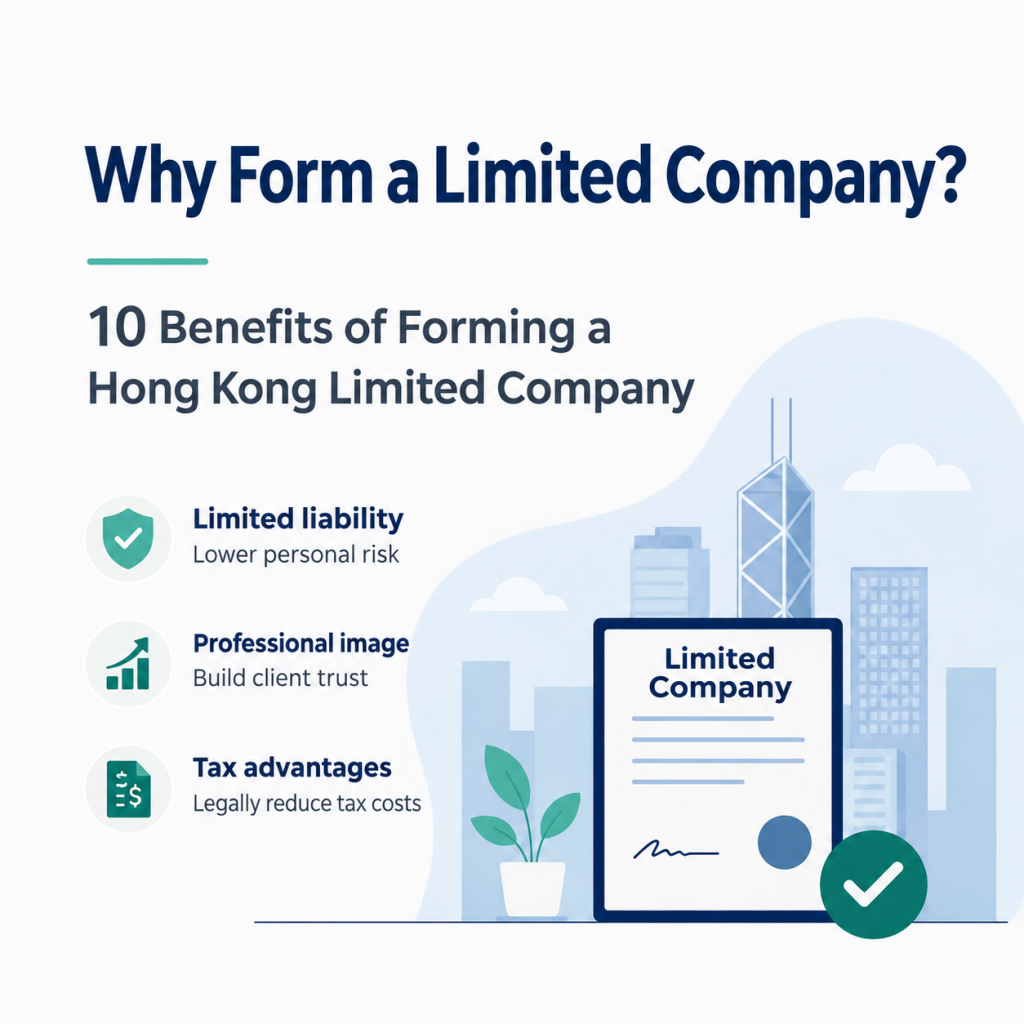
10 Main Advantages of a Hong Kong Limited Company
1. Limited Liability Helps Separate Business Risks from Personal Assets
A Hong Kong limited company is a separate legal entity. For a company limited by shares, shareholders’ liability is generally limited to any unpaid amount on their shares. This separation is particularly important where a business has leases, supplier credit, product liability or large transactions.
If business problems result in unpaid suppliers or contract disputes, liability generally rests first with the company rather than automatically treating all business debts as shareholders’ personal debts. This is a major reason entrepreneurs move from sole proprietorships or partnerships to limited companies.
Limited liability does not eliminate personal responsibility in every circumstance. Personal guarantees for bank loans, leases or other debts, as well as fraud, unlawful conduct or personal misconduct, may still create personal liability.
2. The Company Can Own Assets, Enter Contracts and Bear Obligations
A limited company can own assets, enter contracts, employ staff, receive customer payments and apply for banking services in its own name. Separating business and personal finances makes operations clearer than handling every transaction personally.
Contracts with suppliers, corporate customers and overseas partners can name the company as the contracting party. Existing contracts and assets generally remain with the company despite changes in directors or shareholders.
If you intend to open a business bank account after incorporation, review the Hong Kong Corporate Bank Account Documents and Procedures.
3. A More Established Structure for Corporate Clients and Partners
Many B2B customers, suppliers, payment platforms and partners require a Certificate of Incorporation, Business Registration Certificate, company banking information or director and shareholder details before working together.
A formal company name, registration record and ownership structure provide a clear, continuing corporate identity when quoting, signing contracts, tendering or building long-term relationships.
For entrepreneurs moving from a small operation into the corporate market, incorporation can reduce the administrative work of changing the business entity later.
4. Clear Ownership Makes It Easier to Add Shareholders or Investors
Shares represent ownership in a limited company. Where two or more founders work together, the number of shares and each person’s ownership percentage can be agreed at incorporation.
New shareholders, share transfers, new share issues and investment can be handled through the existing share structure. Compared with a sole proprietorship without shares, a limited company better supports long-term expansion and joint ownership.
For changes to directors, shareholders, the company address or other statutory information after incorporation, Company Secretarial Services can assist with the relevant Companies Registry filings.
5. Continuity Despite Changes in Shareholders
A limited company’s legal identity is separate from individual directors and shareholders. It can continue despite share transfers, director resignations or the introduction of new shareholders.
The same company can retain its name, banking history, customer contracts, trademarks, website, assets and business relationships.
Continuity is especially valuable when a founder wants to develop personal freelance work into an enduring brand that other managers or the next generation can take over.
6. Separate Business and Personal Finances Make Accounting Easier
Small businesses often mix customer income, business expenses, personal spending and owner withdrawals in one account. Once transactions increase, reconstructing the records becomes difficult.
A limited company can maintain its own bank account and accounting records, separately recording sales, rent, salaries, purchases, advertising and other expenses. Clear transaction evidence makes year-end accounts, audits and tax returns easier.
If receipts and banking transactions are numerous, use Accounting and Bookkeeping Services to maintain records regularly. First-time company owners unsure when to begin accounting and audits can also read the First-Year Accounting, Tax and Audit Timetable for Hong Kong Companies .
7. A Clear Profits Tax System with Two-Tier Rates for Eligible Companies
Hong Kong currently operates two-tier Profits Tax rates. For qualifying corporations, the first HK$2,000,000 of assessable profits is taxed at 8.25%, with profits above HK$2,000,000 generally taxed at 16.5%.
Specific restrictions apply to connected entities using the two-tier rates in the same year of assessment. Do not assume that every company automatically qualifies for 8.25%.
Once trading begins, prepare accounts according to income sources, deductible expenses and the company’s overall circumstances. For filing procedures, see Hong Kong Limited Company Tax Return Services.
8. Eligible Operating Expenses May Be Deductible Under Tax Rules
The general Profits Tax principle is that eligible operating expenses incurred in producing assessable profits may be deducted under the relevant rules.
Common expenses may include office rent, payroll, professional fees, advertising and some day-to-day operating costs. Deductibility depends on the actual nature of each expense and applicable tax rules.
Separating company expenses, personal spending and shareholder transactions produces clearer accounts and makes transactions easier to explain to auditors or the IRD.
For common deductions, read our Hong Kong Company Profits Tax Deductible Expenses Checklist .
9. A Suitable Structure for Employees, Processes and Larger Operations
A founder may initially handle sales, purchasing and customer service alone. As orders grow, the business often needs employees, an office or warehouse, and formal payment, purchasing and approval procedures.
A limited company provides a suitable operating entity for sustained expansion. It can centrally handle payroll, MPF, supplier payments, commercial leases and corporate contracts.
For entrepreneurs developing a personal business into an established enterprise, creating clear systems early is generally easier than reorganising a complex operation later.
10. Supports Cross-Border Business and Long-Term Brand Development
Hong Kong limited companies are commonly used for trading, e-commerce, consultancy and other cross-border activities. A mature company framework and standard registration, business registration and ownership documents make it easier to provide information to overseas customers, suppliers and financial institutions.
Incorporation does not guarantee approval of a bank account, payment platform or overseas partnership. Banks and platforms independently review the business, funding sources, transaction locations, customers, suppliers and KYC information.
Prepare evidence of business activity, customer or supplier details and expected transactions alongside incorporation. For more information, see Hong Kong Corporate Bank Account Opening Services.
Limited Companies Also Have Annual Compliance Responsibilities
A company cannot simply be left unattended after incorporation. Separate legal identity and limited liability come with continuing responsibilities under the Companies Ordinance and Hong Kong tax rules.
A typical Hong Kong private limited company must continue to:
- Maintain a Hong Kong registered office address;
- Maintain a qualified Company secretary;
- Keep statutory records and a Significant Controllers Register;
- File its NAR1 annual return on time each year;
- Renew its Business Registration Certificate;
- Keep complete bank statements, invoices, receipts and other accounting records;
- Prepare financial statements and arrange audits according to its circumstances;
- File Profits Tax returns on time when issued by the IRD. See Hong Kong Limited Company Tax Filing.
Organising company secretarial, accounting, audit and tax deadlines from the outset is generally easier than reacting only when government documents arrive each year.
Compare More Than Setup Costs
A limited company’s annual administration usually costs more than a sole proprietorship or ordinary partnership. However, differences extend beyond registration and service fees. Legal responsibility, ownership, audit requirements, corporate image and expansion plans all matter.
| Comparison | Limited Company | Unincorporated business / Sole proprietorship or partnership |
|---|---|---|
| Legal identity | The company is a separate legal entity | Business obligations are more directly linked to the proprietor |
| Liability for debts | Shareholders are generally liable only for unpaid share capital, subject to personal guarantees and other exceptions | The proprietor or general partners generally have more direct personal liability |
| Company secretary | Appointment required | Generally no company secretary requirement |
| Annual return | Required | Generally no annual return to the Companies Registry |
| Accounting and audit | Accounting records must be kept, with financial statements and audits handled according to company circumstances | Accounts and tax returns are required, but generally not the same statutory audit arrangements as a limited company |
| Ownership arrangements | Ownership and transfers can be managed through shares | No share structure |
| Generally suited to | Businesses planning expansion, contracts, inventory, employees, cross-border operations or investment | Low-risk, small-scale, individual businesses or market trials |
The decision is therefore not simply whether extra secretarial and audit fees are worthwhile. Consider future business risks, additional shareholders, larger customers and the long-term separation of business and personal assets.
If you are undecided, read the Complete Comparison of Hong Kong Limited and Unincorporated Businesses .
When Is It Worth Incorporating from the Start?
Consider prioritising a limited company if several of these apply:
- You need an office, shop or warehouse;
- You need employees;
- You need substantial inventory;
- You will obtain supplier credit or sign significant contracts;
- You sell physical products, undertake construction or conduct activities with greater claims exposure;
- You need corporate clients or tender opportunities;
- You conduct cross-border trade or e-commerce;
- You plan to add shareholders or investors;
- You want a brand that can be transferred or passed on over the long term;
- You want to distinguish personal assets clearly from business risks.
For an individual consultant, freelancer or small business testing the market, compare actual costs and responsibilities before deciding whether a limited company is necessary from the outset.
Can an Existing Unincorporated Business Become a Limited Company?
You can form a new limited company and transfer the business to it. This is generally not a simple change from “unlimited” to “limited” on the existing business registration.
In practice, incorporate the new company first, then address customer contracts, suppliers, bank accounts, assets, stock, employees and tax records in stages.
If the business has traded for some time, consider cut-off dates, receivables, payables and asset transfer records before the transition to prevent accounting and tax confusion.
For the detailed steps, read Guide to Moving from an Unincorporated Business to a Limited Company .
Conclusion: A Limited Company Creates Room for Long-Term Operations
The advantages extend beyond limited liability. A company provides a clearer framework for identity, ownership, assets, contracts, accounting records and future development.
A short market trial or low-risk personal service may not require incorporation immediately. If employees, inventory, contracts, corporate customers or new investors are expected, using a limited company from the start can reduce later restructuring work.
Before incorporating, set out the business model, shareholder numbers, revenue sources, banking needs and plans for the next two or three years, then choose the appropriate structure.
For the procedures, government fees and required documents, read Hong Kong Company Registration Procedures and Fees Guide .
Planning a Hong Kong limited company but unsure about ownership, the secretary, registered office, banking or tax arrangements? Use M&N’s Contact Us page to enquire about registration and related business services.
Hong Kong Limited Company FAQs
1. Can One Person Set Up a Hong Kong Limited Company?
Yes. One person may be both shareholder and director of a private limited company. A qualified company secretary is still required, and a sole director cannot also be secretary of the same company.
2. Does a Limited Company Always Protect Personal Assets?
No absolute guarantee applies. Limited liability primarily separates company debts from shareholder responsibility. Personal guarantees, fraud, unlawful conduct and other personal liabilities may still have consequences for directors or shareholders.
3. Is the First HK$2 million of Profit Always Taxed at 8.25%?
For qualifying corporations, the first HK$2,000,000 of assessable profits is taxed at 8.25%, with the remainder generally at 16.5%. Restrictions apply to elections by connected entities, so eligibility depends on relationships and filing circumstances.
4. Is Overseas Business Automatically Exempt from Hong Kong Profits Tax?
No. Hong Kong applies a territorial source principle. Taxability depends on the actual profit-producing activities and facts, rather than simply overseas customers, exported goods or the currency received.
5. Does Having No Income Remove Annual Return and Tax Obligations?
No. A lack of income does not automatically suspend statutory duties. Company secretarial, annual return, business registration and statutory record obligations remain subject to the rules. Accounting, audit and tax treatment depend on transactions and actual circumstances.
6. Can an Unincorporated Business Be Changed Directly into a Limited Company?
This generally involves more than changing existing business registration. A new company is usually incorporated and contracts, assets, banking, customers and tax records are transferred progressively. See Guide to Moving from an Unincorporated Business to a Limited Company .
7. Must Every Online Shop or Freelancer Form a Limited Company?
No. A simpler structure may suit low-risk personal services with small transactions. A limited company often helps separate risks where there is substantial stock, product liability, platform trading, employees, overseas customers or larger transactions.
Online shop operators can also read the Hong Kong Online Shop Business Registration and Tax Guide .
8. Does Incorporation Guarantee a Bank Account?
No. Registration and account opening are separate. Banks assess the business, funding sources, transaction locations, directors, shareholders, customers and suppliers under their own due diligence and risk policies.
Article Sources
- Hong Kong Companies Registry: Company Responsibilities
- Hong Kong Companies Registry: Incorporating a New Company
- Hong Kong Companies Registry: Directors and Company Secretaries FAQs
- Hong Kong Companies Registry: Annual Returns of Local Private Companies
- Hong Kong IRD: Profits Tax
- Hong Kong IRD: Two-Tier Profits Tax Rates
- Hong Kong IRD: A Brief Guide to the Territorial Source Principle