For many people starting a business in Hong Kong, the first question is whether to form a limited company or operate an unincorporated business. Both structures can legally conduct business, but they differ substantially in legal liability, start-up costs, audit and tax filing requirements, ongoing compliance, and future development. Choosing solely on the basis of start-up fees may overlook the risks the business will face. For an overview of the application process, see our Guide to Starting a Business in Hong Kong: Procedures and Costs.
This article compares limited companies and unincorporated businesses using situations commonly encountered by Hong Kong entrepreneurs and explains which structure may suit different types of business.
What Does an Unincorporated Business Mean in Hong Kong?
In everyday Hong Kong business terminology, an unlimited business generally means an unincorporated business operated as a sole proprietorship or partnership, rather than a separate legal entity distinct from its owners. This article uses unincorporated business as a collective term for sole proprietorships and general partnerships.
This distinction matters: once incorporated, a limited company is a separate legal entity, whereas the liabilities of an unincorporated business ultimately remain with its proprietor or partners.
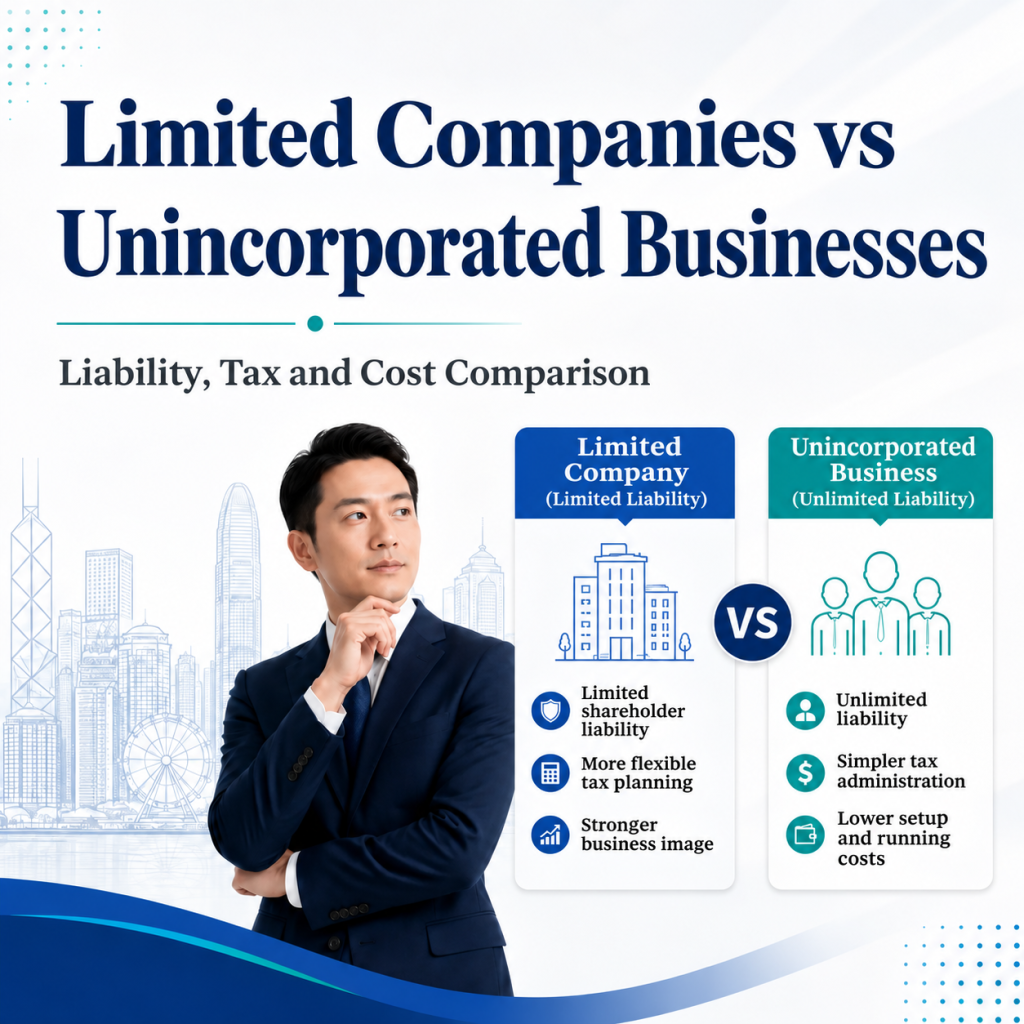
Limited Companies and Unincorporated Businesses: A Quick Comparison
| Comparison | Limited Company | Unincorporated Business (Sole Proprietorship / Partnership) |
|---|---|---|
| Legal status | A separate legal entity that can own assets, enter into contracts, and bear legal liability | Not a separate legal entity; the proprietor or partners ultimately bear the liabilities |
| Liability for debts | Shareholders’ liability is generally limited to the unpaid amount on the shares they have subscribed | The proprietor or partners bear unlimited personal liability |
| Formation procedures | Company incorporation and business registration through the Companies Registry | Generally, business registration with the Business Registration Office |
| Company secretary | A company secretary must be appointed | No statutory requirement for a company secretary |
| Annual return | An annual return must be filed on time | No annual return to the Companies Registry is required |
| Accounting and audit | Accounts must be maintained; financial statements generally require an audit, except for dormant companies | Accounts and tax filing are required, but there is generally no statutory audit requirement |
| Two-tiered Profits Tax | 8.25% on the first HK$2,000,000 of assessable profits; 16.5% thereafter | 7.5% on the first HK$2,000,000 of assessable profits; 15% thereafter |
| Financing and investment | Share arrangements allow new shareholders to invest, supporting financing and expansion | No share structure, making investment and business transfers less straightforward |
| Continuity | Changes in shareholders or directors generally do not affect the company’s continued existence | Changes in ownership or the partnership can more readily affect business continuity |
| Overall costs | Higher formation and annual maintenance costs | Lower formation and ongoing maintenance costs |
One: The Main Difference — Who Is Responsible for Business Debts?
Limited Companies: Company and Shareholder Liabilities Are Generally Separate
A limited company has separate legal status after incorporation. It can hold assets, open bank accounts, enter into contracts, borrow, and conduct legal proceedings in its own name. Generally, the company is responsible for its debts, while shareholders’ liability is limited to the unpaid amount on their subscribed shares. For incorporation requirements, see our Hong Kong Limited Company Incorporation Service.
Limited liability does not remove personal responsibility in every situation. If a shareholder or director has given a personal guarantee for a company loan, lease, or supplier credit, the debt may still be pursued against that individual. Fraud, unlawful conduct, or serious misconduct may also result in personal liability.
Unincorporated Businesses: Business Risks Can Directly Affect Personal Assets
An unincorporated business is not a legal entity separate from its owners. If the business cannot pay rent, suppliers, compensation, or other debts, the proprietor or partners may have to meet those liabilities using personal savings and other assets. For formation procedures and required documents, see our Hong Kong Unincorporated Business Registration Service.
An unincorporated business is therefore more suited to lower-value transactions, limited inventory, and low exposure to substantial claims. Before renting a shop, employing several people, providing engineering or construction services, selling physical products, or signing substantial contracts, assess the potential risk to personal assets.
Two: How Do Formation Procedures and Government Fees Differ?
Setting up an unincorporated business is more straightforward. A sole proprietorship or partnership generally needs to apply for business registration within one month of commencing business. A limited company must handle both incorporation and business registration and prepare documents such as its Articles of Association and director and shareholder particulars. [1]
| Government Fees as at July 2026 | Limited Company | Unincorporated Business |
|---|---|---|
| Company incorporation fee | Electronic application: HK$1,545; paper application: HK$1,720 | Not applicable |
| One-year business registration fee and levy | HK$2,350 | HK$2,350 |
| Estimated minimum government fees | Total for electronic application: HK$3,895 | HK$2,350 |
These amounts cover government fees only. They exclude company secretarial services, a registered address, accounting, audit, document handling, and professional service fees. Government charges may change with annual policy adjustments, so check the latest fees before applying. [2] [3]
Three: Do Lower Profits Tax Rates Make an Unincorporated Business Better Value?
Under Hong Kong’s two-tiered Profits Tax system, limited companies are corporations, with the first HK$2,000,000 of assessable profits taxed at 8.25% and the balance at 16.5%. Unincorporated businesses are taxed at 7.5% on the first HK$2,000,000 and 15% on the balance. [4]
Looking at tax rates alone, an unincorporated business appears cheaper. Choosing a structure also requires consideration of audit and company secretary fees, personal risks, profit distribution, funds retained for growth, and whether personal assessment is suitable for the proprietor. A lower tax rate does not necessarily mean a lower overall cost.
Once actual operating figures are available, estimate assessable profits and compliance costs under both structures. The M&N website also provides information on Hong Kong Limited Company Tax Filing and Hong Kong Unincorporated Business Tax Filing .
Four: Bookkeeping, Audit, and Annual Filing Requirements
Limited Companies Have More Compliance Obligations
After incorporation, a limited company must continue to manage its company secretary, registered address, statutory records, annual returns, accounting, Profits Tax filing, and audits. A private limited company generally needs to file its annual return within 42 days of the incorporation anniversary. Late filing attracts higher registration fees and may expose the company and responsible persons to legal liability. [5]
For financial reporting, Hong Kong companies’ financial statements generally require an audit, except where a company meets the conditions for dormant status. A small business size does not mean that bookkeeping and audit arrangements can be omitted. [6]
A company secretary helps the company manage statutory filing and information-update deadlines. For details, see our Company Secretarial Services; for day-to-day bookkeeping, financial statements, and audit preparation, see our Accounting and Bookkeeping Services.
Unincorporated Businesses Have Less Administration but Still Need Accounts and Tax Filing
Unincorporated businesses do not need to file annual returns with the Companies Registry and generally have no statutory audit requirement, so their annual maintenance costs are usually lower. However, proprietors or partners must still retain complete income and expense records, supporting documents, bank records, and business documents, and submit Profits Tax returns as required by the IRD.
No audit requirement does not mean no bookkeeping is needed. Inadequate accounts make assessable profits harder to substantiate and can complicate responses to tax enquiries.
Five: Business Image, Financing, and Future Expansion
Customers often see a limited company as having a clearer corporate structure and greater continuity. A limited company is generally better suited to tendering, serving corporate clients, obtaining bank finance, introducing investors, or arranging share transfers. Ownership can be adjusted through share issues or transfers, while business assets, contracts, and the brand can be clearly held by the company.
An unincorporated business is run directly by its proprietor, allowing quick decisions. It is particularly suited to personal services, freelancing, small online shops, or low-risk trial operations. As staff, inventory, lease commitments, or business partners increase, the original structure may become less suitable.
Six: Who Might Choose an Unincorporated Business?
Consider starting as an unincorporated business if:
- The business is run by one person or a small number of partners, with relatively straightforward decisions and accounts;
- Contract, inventory, and compensation risks are low;
- Initial turnover and profits are limited and you want to control fixed compliance costs;
- There are no immediate plans to raise finance, introduce shareholders, or sell shares;
- The proprietor clearly understands and accepts unlimited personal liability.
Examples include independent consultants, designers, photographers, small tutoring services, individually operated online shops, and service businesses still testing their market. Businesses in the same industry can nevertheless face very different risks, so the decision should not be based solely on the type of business.
Seven: Which Businesses Are Better Suited to a Limited Company?
A limited company usually deserves priority consideration if you:
- Need to rent a shop, office, or warehouse under a longer lease;
- Need employees, substantial inventory, or supplier credit;
- Operate in engineering, products, logistics, catering, or another area with potential claims exposure;
- Need to serve large corporate clients, conduct cross-border transactions, tender, or participate in government-funded projects;
- Plan to introduce shareholders or investors, or eventually sell or pass on the business;
- Want a clear separation between company assets, branding, contracts, and personal assets.
Eight: Can an Existing Unincorporated Business Convert Directly into a Limited Company?
Usually, you cannot simply change the existing business registration from an unincorporated business to a limited company. In practice, you generally need to incorporate a new limited company and then transfer the existing business’s contracts, assets, customer arrangements, employees, licences, bank receipts, and tax records individually.
The transfer involves many items, and incomplete handling can mix up the accounts of the old and new businesses. For the steps involved, see our Guide to Moving from an Unincorporated Business to a Limited Company .
Limited Company or Unincorporated Business? 5 Questions to Help You Decide
- In the worst case, how much debt or compensation could the business owe?
- Will I need to personally guarantee a lease, borrowing, or supplier credit?
- Will I hire more staff, open additional locations, or bring in investors over the next two to three years?
- Will customers or partners require a limited company as the contracting party?
- Is a low-cost start more important to me, or separating personal assets from business risks?
If most answers involve substantial liabilities, expansion, financing, or corporate customers, a limited company is usually more suitable. If the business is still being tested, carries low risk, and has a simple structure, an unincorporated business can offer a lighter starting point.
Conclusion: Look Beyond Start-Up Costs
The central difference between a limited company and an unincorporated business is not simply government fees or tax rates. It is whether business risks are borne by the company or personally by its owners. An unincorporated business is simpler to establish and cheaper to maintain, but involves greater personal liability. A limited company has more compliance requirements, yet is often better suited to building a brand, handling larger operations, and pursuing long-term growth.
Every business has a different revenue model, contractual arrangements, and risk profile. Before starting, prepare estimates of turnover, costs, contract values, staff numbers, and growth plans, then ask a professional adviser to compare the structures. For help with assessment or registration, contact M&N Business.
Frequently Asked Questions
1. What Is the Main Difference Between a Limited Company and an Unincorporated Business?
The main difference is legal liability. A limited company is a separate legal entity and generally bears its own debts. An unincorporated business usually means a sole proprietorship or partnership, whose proprietor or partners bear unlimited personal liability for business debts.
2. Are Profits Tax Rates Always Lower for an Unincorporated Business?
Under the two-tiered Profits Tax system, rates for unincorporated businesses are lower than those for corporations. However, the choice should not be based on nominal rates alone. Audits, company secretarial services, personal assessment, business expenses, retained profits, and personal risks all affect actual costs.
3. Does an Unincorporated Business Need an Audit?
There is generally no statutory audit requirement, but sufficient accounting records must still be kept, income and expenditure organised, and tax returns filed on time. If the IRD makes enquiries, the proprietor must substantiate the reported figures with accounts and supporting documents.
4. Does a Limited Company Need an Audit Every Year?
Except for companies meeting the conditions for dormant status, Hong Kong companies’ financial statements generally require an audit. Even with limited turnover, accounting and tax filing should reflect the actual transactions and company circumstances.
5. Can One Person Establish a Limited Company?
Yes. One person can act as both shareholder and director of a Hong Kong private limited company. The company must still appoint a company secretary; where there is only one director, that director cannot also be the company secretary.
6. Can an Unincorporated Business Keep Its Name When Moving to a Limited Company?
Usually, you first need to check whether the limited company name is available, then incorporate the new company and arrange the business transfer. The existing business registration, bank accounts, contracts, and tax records do not automatically transfer to the new limited company.
7. Should an Online Shop or Freelancer Choose a Limited Company or an Unincorporated Business?
For low-risk personal services and small transactions, an unincorporated business can provide a lower-cost start. If substantial inventory, product liability, overseas customers, employees, or significant refund and claims risks are involved, a limited company is usually better for separating risks.
8. If a Company Has No Income, Can It Stop Tax Filing and Maintenance?
No. Even if a limited company temporarily has no income, it must still manage business registration, its company secretary, statutory records, and tax documents. The treatment depends on whether the company has transactions and meets the conditions for dormant status.
Article Sources
- Hong Kong Inland Revenue Department: Businesses Requiring Business Registration and Application Deadlines
- Hong Kong Companies Registry: Principal Company Incorporation Fees
- Hong Kong Inland Revenue Department: Business Registration Fee and Levy Table
- Hong Kong Inland Revenue Department: Profits Tax Rates and the Two-Tiered Profits Tax System
- Hong Kong Companies Registry: Annual Return Requirements for Private Companies
- Hong Kong Companies Registry: Companies Ordinance FAQs on Accounts and Audit