
The key point: Marriage does not automatically require a joint tax return. Hong Kong’s formal tax term is joint assessment. Even with joint assessment, each spouse must submit a separate BIR60. For the 2025/26 year of assessment reported in 2026, the married person’s allowance is HK$264,000. It rises from the 2026/27 year of assessment to HK$290,000.
Which method saves more? The answer depends on the spouses’ income difference, unused allowances and deductions, and the 2025/26 tax reduction capped at HK$3,000 per case, rather than simply a larger married person’s allowance.
The Married Person’s Allowance in 2026: HK$264,000 or HK$290,000?
Both figures are correct, but apply to different years of assessment:
| Item | 2025/26 year of assessment | From the 2026/27 year of assessment |
|---|---|---|
| Basic allowance per person | HK$132,000 | HK$145,000 |
| Married person’s allowance | HK$264,000 | HK$290,000 |
The final assessment for 2025/26, filed in 2026, therefore still uses HK$264,000. HK$290,000 has been enacted but takes effect only from 2026/27. A single demand note may show both the 2025/26 final assessment and 2026/27 provisional tax, so the two different allowances are not inconsistent.
For progressive rates, the basic allowance and other deductions, see M&N’s Hong Kong Salaries Tax Guide.
The Married Person’s Allowance Is Not an Extra HK$264,000
A common misconception is that it is an additional allowance. Under separate assessment for 2025/26, each spouse has a basic allowance of HK$132,000, totalling HK$264,000. Joint assessment uses one married person’s allowance of HK$264,000.
The real advantage is that the lower-income spouse’s unused allowances and qualifying deductions can offset the couple’s combined employment income. However, both incomes share one set of progressive bands, so separate assessment is usually more favourable when earnings are similar or both are relatively high.
Should You Elect Joint Assessment? 3 Common Situations
| Couple’s circumstances | General approach | Reason |
|---|---|---|
| Only one spouse has employment income | Joint assessment is unnecessary | The earning spouse can claim the married person’s allowance |
| Both have employment income, but one earns less than their total allowances and deductions | Consider joint assessment | Unused amounts belonging to the lower-income spouse can be used |
| Earnings are similar or both are relatively high | Separate assessment is usually more favourable | Each spouse can use separate progressive bands |
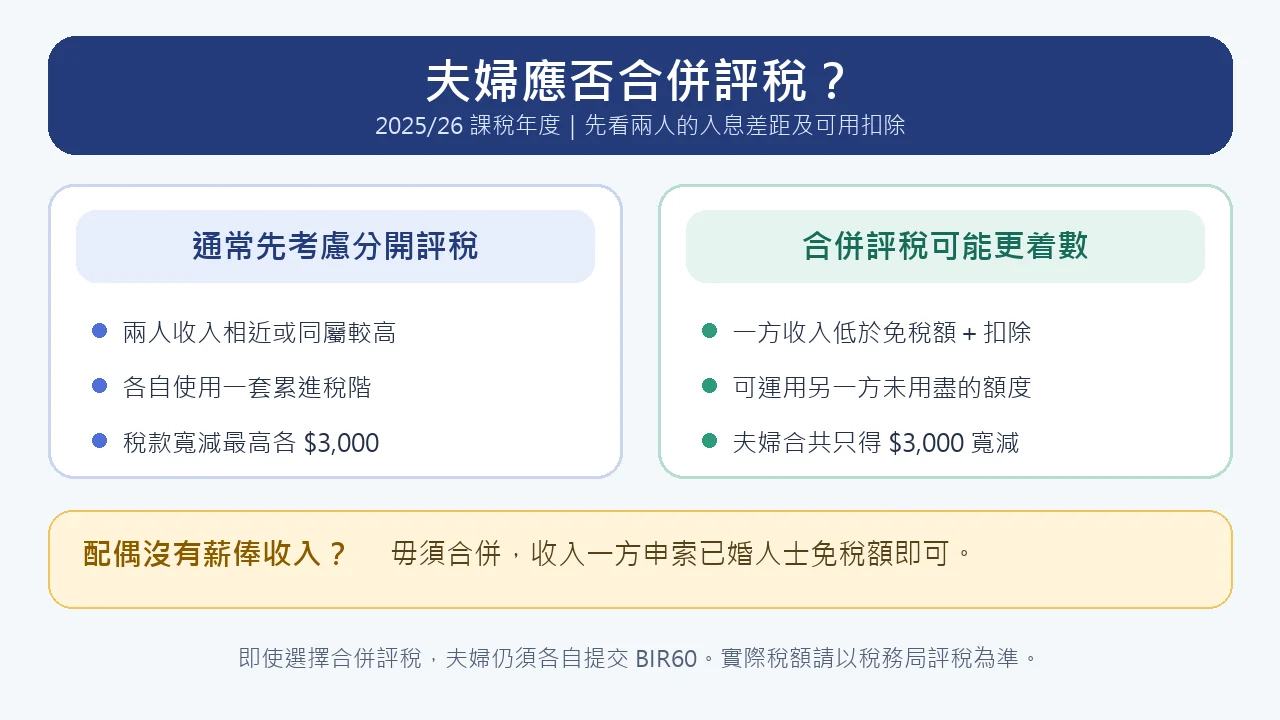
Note: If a spouse has no income chargeable to Salaries Tax and has not separately elected Personal Assessment, the earning spouse need only claim the married person’s allowance in Part 12.1 of BIR60. Joint assessment is unnecessary.
Official IRD Example: Joint Assessment Saves HK$3,060 Where Incomes Differ
The IRD provides the following comparison for 2025/26:
Example One: Monthly Salaries of HK$45,000 and HK$10,000
The couple has a daughter, with MPF contributions and child allowance taken into account:
- Separate assessment: Tax payable of HK$23,200
- Joint assessment: Tax payable of HK$20,140
- Joint assessment saves HK$3,060
The lower-income spouse cannot fully use their allowances; joint assessment applies the unused portion against the other spouse’s income.
Example Two: Monthly Salaries of HK$45,000 and HK$35,000
Using the same child and MPF assumptions:
- Separate assessment: Combined tax of HK$48,100
- Joint assessment: HK$69,100
- Separate assessment saves HK$21,000
Here, separate progressive bands are more beneficial. If the IRD finds joint assessment disadvantageous, it will use separate assessment and explain this in the assessor’s notes on the notice of assessment.
The 2025/26 Factor: Tax Reduction of Up to HK$3,000 per Case
Final Salaries Tax and tax under Personal Assessment for 2025/26 qualify for a 100% reduction capped at HK$3,000 per case. This is not a cash rebate or a direct deduction from provisional tax.
- Separate assessment: Each spouse has a separate case, giving a combined maximum reduction of HK$6,000.
- Joint assessment: The couple has one case, with a maximum reduction of HK$3,000.
When comparing methods for 2025/26, include the tax reduction cap as well as allowances.
How Do You Elect Joint Assessment on BIR60?
- Each spouse completes and submits their own BIR60, reporting their own income, expenses and deductions.
- Elect joint assessment in Part 4.4.
- Complete Part 12.1 to claim the married person’s allowance.
- Both spouses sign Part 13 to indicate consent.
Joint assessment must be elected again each year. Generally, an election or withdrawal must be made during the relevant or following year of assessment, or within one month after the assessment becomes final, whichever is later. Once withdrawn, it cannot be elected again for that year.
The IRD compares joint and separate assessment. If joint assessment is disadvantageous, it normally uses the more favourable separate method. As joint assessment is voluntary, the IRD cannot apply it without a valid election.
How Does Joint Assessment Differ from Personal Assessment?
joint assessment combines only the spouses’ employment income; Personal Assessment combines salaries, business profits and property income, with relevant deductions or losses.
Couples with only employment income usually need not elect Personal Assessment. If either spouse has rental income, sole-proprietorship profits or business losses, compare Personal Assessment separately. M&N can review the actual income and deductions to provide a complete comparison.
Married Couples’ Tax FAQs
Must We Elect Joint Assessment After Marriage?
No. Separate Salaries Tax assessment is the default; joint assessment is voluntary.
Do We Submit Only One Return After Electing Joint Assessment?
No. Each spouse still submits BIR60 and reports their own income and deductions, with both signing to indicate consent.
Is Joint Assessment Needed When My Spouse Has No Income?
Generally not. The earning spouse can claim the married person’s allowance in Part 12.1 of BIR60, provided the other spouse has no income chargeable to Salaries Tax and has not separately elected Personal Assessment.
Will an Unfavourable Joint Assessment Election Necessarily Increase Tax?
The IRD compares both methods and normally applies separate assessment if it is more favourable, notifying the couple. However, it cannot apply joint assessment without a valid election.
Why Might a 2026 Demand Note Show Both HK$264,000 and HK$290,000?
HK$264,000 applies to the 2025/26 final assessment. HK$290,000 applies from 2026/27 and may appear in the 2026/27 provisional tax section on the same demand note.
Conclusion: Compare the Figures Before Deciding
Joint assessment is usually unnecessary when one spouse has no income. It may help where one earns less and has unused allowances or deductions. Separate assessment is often better when earnings are similar or both high. Compare both spouses’ salaries, MPF, home loan interest, child and other allowances together.
If you want to calculate the position before filing, submitting additional information or responding to an assessment, explore M&N’s Tax Filing Services and Accounting and Bookkeeping Services for assistance based on your circumstances.
Information is current to 23 August 2026 as stated in the article. This is general reference material; actual treatment depends on individual circumstances and the IRD’s final assessment.