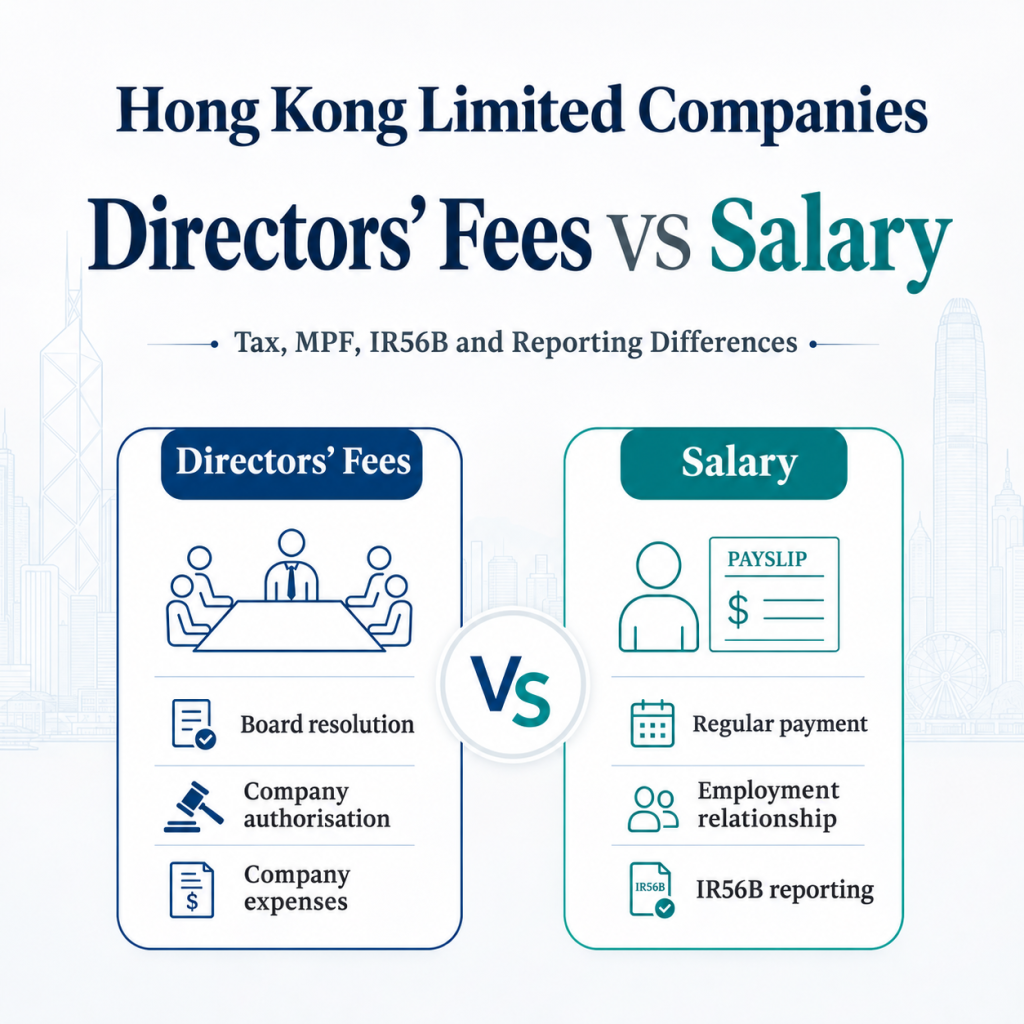
Many Hong Kong SME owners are both shareholders and directors. Once revenue begins, a practical question arises: should monthly payments from the company be director’s fees or salary? Some have heard that director’s fees do not require MPF contributions; others believe calling pay a “Director Fee” reduces tax.
The payment label does not determine whether it is a director’s fee or salary. Relevant factors include the recipient’s capacity, involvement in daily operations, any employment relationship, and the company’s approvals, payroll records, MPF arrangements and employer’s returns.
For personal filing information, see M&N’s Individual Tax Filing Services.
Director’s Fees vs Salary: Key Differences
| Comparison | Director’s fee | Salary |
|---|---|---|
| Main nature | Remuneration for holding office as a director and performing directors’ duties | Remuneration for employment involving daily management, sales, operations, finance or other work |
| Salaries Tax | Generally income chargeable to Salaries Tax | Generally income chargeable to Salaries Tax |
| IR56B | Director’s fees must be reported under the applicable rules | Salary must be reported under the applicable rules |
| MPF | The label is not decisive: an executive director involved in daily operations and receiving remuneration may need MPF enrolment | Employees covered by MPF rules who are not exempt generally need enrolment |
| Source of cross-border income | Fees for a directorship in a Hong Kong company are generally treated under the rules for an “office” | Depends on the source of employment, where services are performed and applicable exemptions |
| Common documents | Remuneration approvals or resolutions, payment records, IR56B and related documents | Employment contract, payslips, MPF, payment records, IR56B and related documents |
1. What Is a Director’s Fee?
A director’s fee relates to the office of director itself. Examples include attending board meetings, approving major matters and fulfilling governance and directors’ responsibilities. Remuneration for these duties is more characteristic of a director’s fee.
Renaming an owner’s monthly withdrawals does not make them director’s fees. Clear approvals and records should support consistent accounting, bank payments, corporate documents and employer’s returns.
2. What Is a Director’s Salary?
A director may also work for the company. A common example is a founder handling sales, operations, purchasing, finance or team management each day and receiving fixed monthly pay. This is more characteristic of employment salary.
IRD guidance recognises that a person may hold a directorship and be employed by the same company. Director and employee are not mutually exclusive roles. If remuneration is divided into salary and fees, both should reflect genuine duties supported by documents.
3. Which Attracts Less Salaries Tax?
Neither label inherently carries a lower rate. The IRD lists salaries, wages and director’s fees as taxable remuneration reportable by employers. The individual’s liability depends on total annual taxable income, deductions, allowances and applicable rates.
The claim that director’s fees always save more tax than salary is therefore unreliable. Differences may arise from MPF, income source, deductions and the person’s overall income structure.
4. Can the Company Deduct Director’s Fees or Salary for Profits Tax?
The important questions are whether the expense is genuine and incurred in producing assessable profits, rather than whether it is called salary or a director’s fee. The general Profits Tax principle allows eligible expenses incurred in producing assessable profits to be deducted under the rules.
If the recipient is also a major shareholder or related party, retain evidence supporting reasonable remuneration, duties, approvals, payroll and payments. A year-end figure alone may not explain how the remuneration arose.
When preparing year-end accounts, review director remuneration alongside Accounting and Bookkeeping、 Hong Kong Limited Company Tax Filing to reduce the need to reconstruct documents during audits or tax filing.
5. A Major Misconception: Director’s Fees Are Not Automatically Exempt from MPF
This is a common source of error. The MPFA’s current FAQs state that an executive director who handles daily company operations and receives remuneration, including director’s fees, must be enrolled in MPF by the company. A non-executive director who does not participate in daily operations is treated differently.
Changing the monthly payment label from salary to director’s fee does not automatically remove MPF obligations. Assess whether the director works in daily operations and receives remuneration in a manner similar to an employee, then apply the rules to the actual role.
6. Working in Mainland China or Overseas Does Not Automatically Make Director’s Fees Overseas Salary
Cross-border directors should distinguish an “office” from “employment” for tax purposes. The IRD’s guide for people working in Hong Kong treats a directorship as an office. A remunerated director of a Hong Kong company generally holds a Hong Kong office, and the remuneration is normally considered under Hong Kong Salaries Tax rules.
Employment salary requires further consideration of the employment source, actual service location and exemptions. Long-term work in mainland China does not automatically make all remuneration from a Hong Kong company offshore income. Analyse the office and employment arrangements separately.
7. Employer Reporting: Do Not Overlook IR56B
IRD employer guidance lists salary and director’s fees as reportable remuneration. Directors’ salary and fees should be reported through the employer’s return and forms such as IR56B under the applicable rules.
The greatest practical difficulty is often inconsistent accounts, bank payments, IR56B, MPF and personal returns. Examples include regular company payments recorded as director remuneration but omitted from employer reporting, or personal income reported without corresponding payroll records. Such inconsistencies complicate audits and tax enquiries.
8. How Should an Owner Assess Payments to Themselves?
| Actual circumstances | Likely treatment | Reason |
|---|---|---|
| Daily operational work with defined duties and monthly remuneration | Primarily salary | More consistent with employment, payroll, MPF and employer reporting |
| Mainly board, oversight and governance duties without daily operational involvement | Director’s fees are more common | Remuneration relates directly to the office of director |
| Both daily management and separate directors’ duties | Record separately according to the actual roles | Both types need clear duties, amounts and approvals |
| Occasional withdrawals without an established classification | Clarify the accounting nature first | Payments may be remuneration, shareholder transactions, loans, dividends or something else; do not force a new label retrospectively |
First ask what work or capacity the payment genuinely relates to, then decide how to account for and report it. This is generally more reliable than choosing the label that appears to save the most tax.
9. Director’s Fees, Salary and Dividends Are Different
Director’s fees remunerate the office of director; salary remunerates employment; dividends distribute available profits to shareholders in their capacity as owners. The IRD states that dividends received by limited company shareholders need not be reported on IR56B, while directors’ remuneration and fees fall under Salaries Tax rules.
Do not relabel all remuneration for actual work as dividends simply because dividends are not salary. Distributions require available profits and appropriate corporate and accounting procedures.
10. The 5 Most Common Director Remuneration Mistakes
- Assuming director’s fees never require MPF, despite daily involvement in company operations;
- Making fixed monthly payments throughout the year and renaming them director’s fees at year-end;
- Lacking clear remuneration approvals, employment arrangements or payroll records;
- Assuming remuneration from a Hong Kong company need not be reported in Hong Kong solely because the director is overseas;
- Inconsistent figures across accounts, IR56B, MPF and personal returns.
Frequently Asked Questions
1. Are Director’s Fees Subject to Salaries Tax?
They generally need to be considered under Salaries Tax rules. The IRD lists director’s fees among taxable remuneration reportable by employers. Actual tax is calculated together with the individual’s other income, deductions and allowances.
2. Are Director’s Fees Always Exempt from MPF?
No. The MPFA states that executive directors handling daily operations and receiving remuneration, including director’s fees, must be enrolled as required. Non-executive directors without daily operational involvement are treated differently.
3. Can a Director Receive Both Salary and Fees?
Potentially. The IRD recognises that an individual may hold office and employment in the same company. Both payments should correspond to genuine roles and duties, supported by clear documents and reporting records.
4. Can an Owner’s Monthly Withdrawals All Be Classified as Director’s Fees at Year-End?
Simply changing the name at year-end is not recommended. Establish the actual nature of payments and keep accounting, approvals, IR56B and MPF treatment consistent.
5. Are Fees Paid to a Director Working Overseas or in Mainland China Exempt from Hong Kong Tax?
That conclusion cannot be drawn automatically. A directorship in a Hong Kong company generally constitutes a Hong Kong office, and source rules differ between director’s fees and employment salary. Analyse the actual office, employment and work location.
6. Can a Company Deduct Salary or Fees Paid to Directors?
It depends on whether the expense is genuine and incurred in producing assessable profits. Related-party remuneration particularly requires records of duties, approvals, payments and accounting.
7. Must Director’s Fees Be Reported on IR56B?
IRD employer guidance states that directors’ remuneration and fees fall within Salaries Tax and should be reported through IR56B and other employer reporting documents as applicable.
M&N’s Advice: Establish Remuneration Arrangements Before Payments Begin
The main risk is inconsistency between actual practice throughout the year and year-end documentation. For SME owner-directors, establish employment status, MPF applicability, approval procedures and accounting and IR56B treatment before regular payments begin. This is generally more reliable than reconstructing records afterwards.
M&N Business Services can work with Individual Tax Filing、 Accounting and Bookkeeping、 Tax Filing Services and Hong Kong Limited Company Tax Filing to organise the relevant information.
Does your company already make director withdrawals, salary payments or fees that you are unsure how to classify? You can contact M&N Business to assess the actual records.